Friday, July 2, 2010

111. Come on People: On the Path from Victims to Victors - Bill Cosby and Alvin F. Poussaint, M.D.

Come on People is based on the theme of Cosby's popular "call out" sessions where he has drawn attention to the crises among the black community in America and where he has challenged African Americans to restore their families and communities. In this book, Cosby and Poussaint give a very in-depth analysis of issues like violence, drugs, lack of education obesity, poverty, and broken families. From the chapter about violence:
Low self-esteem can cause a kid to do things that are physically and mentally self-destructive. These are lost, mixed-up youths. Kids who are depressed, angry, or suffering from mental illnesses need to get counseling. They may cry out in desperation, but they do not know how to ask for help and too often reject it when it is offered. They'd rather kill to gain a modicum of self-respect than come in from the cold.

The book is written as more of a guide than as just complaints about the state of black America. Cosby and Poussaint encourage readers to be actively involved in the education and upbringing of their children; to stay out of credit card debt; to listen to music that uplifts rather than degrades; and to take their neighborhoods back from drug dealers. In the chapter about going from poverty to prosperity, the authors encourage readers to find legitimate jobs.
Parents and caregivers, have you heard a kid say, "Well I can either flip burgers or go out here and make some real money selling drugs" ? When you hear that, do you stop that child and say, "Wait a minute, fool. You don't flip burgers for the rest of your life. You flip them to become the manager of that place. You flip burgers to move from manager to owner of the damn franchise" ?

While I appreciate the valuable suggestions on ways to overcome these hardships, it was very obvious to me while reading this book that the people who need it most would likely (sadly) not be reading. The authors tell parents to stop using the television to babysit their children; they also tell mothers whose children might admit that they are being fondled by an adult not to allow it to continue just because that adult might be helping with rent or bills. Maybe I'm being pessimistic, but would the mother who sits her kids in front of the TV and who allows her boyfriend who's paying the rent to fondler her daughter really be sitting down to read this book? I hope that it is able to reach the academics, sociologists, clergy, and teachers ... and also the target audience that really needs it.

Monday, June 28, 2010

110. A Reliable Wife - Robert Goolrick

Don't be fooled by the chaste title and conservative cover of this book! Set in a small Wisconsin town in the early 1900's, A Reliable Wife tells the story of Ralph Truitt, a wealthy businessman who places an advertisement for a wife in newspapers across the country: "Country businessman seeks reliable wife. Compelled by practical not romantic reasons ..."
The woman he ends up choosing is Catherine Land - a woman who describes herself as "a simple, honest woman," though she is far from that. I don't want to give away too much, but her past is haunted by sex and lies that all tie in with her choosing to move to Wisconsin to become Ralph's wife. The crux of her plan in moving there was to slowly poison Ralph with arsenic and then to become a wealthy widow - she did not count on actually falling in love with him. But Ralph certainly harbors some twisted secrets of his own.
The plot keeps this book interesting, but the writing makes it amazing. Here is an excerpt from when Ralph is waiting for Catherine to arrive in Wisconsin at the train station:

Standing in the center of the crowd, his solitude was enormous. He felt that in all the vast and frozen space in which he lived his life- every hand needy, every heart wanting something from him- everybody had a reason to be and a place to land. Everybody but him. For him there was nothing. In all the cold and bitter world, there was not a single place for him to sit down.
And here's an example of why I said this book is not as chaste and conservative as the title and cover may make it seem:

Her blood was water. Her eyes were blind. She was not Catherine. She was not anybody. Nobody knew where she was ... She stood in the kingdom of touch, and it was ecstasy to her. They made love as if someone were watching ... She was on his bed, her clothes in ruins on the floor, and he was naked too, she lying sideways on the bed, her bones gone, he moving above and on and at her, his tongue expertly bringing her to climax so fast and so deeply that she went on rolling with warmth and pleasure as he entered her and brought himself to coming, letting out a cry as he did so, his only sound. It was his own masculinity he was making love to, which drove him as he rode inside her, rapture at his own skill, his own pleasures, the tenderness, the savagery, ripping through her as though for the first time ...
Yeah - I wasn't ready for all of that, either! I wish I could have seen my facial expressions as I was reading this book - Goolrick paints such a beautifully detailed picture of each and every scene. The only reason I'm not putting it on my top 10 list of fiction books is that many parts were too obviously written by a man. Some of the passionate scenes were beautiful, but Goolrick simply didn't capture them from a woman's perspective. If he was writing for men, then that's great - and I'd be interested to hear men's views of this book. But for me, there was only about an 80% connection. Nonetheless, if you're looking for a tasteful yet slightly edgy fiction book, this is it.

109. Planet Google - Randall Stross

In Planet Google, New York Times columnist Randall Stross provides a behind-the-scenes look at Google's massively ambitious plan: to become the one-stop shop for the world's information needs. Stross explains how one of the philosophies behind Google's plan is that information should be open and accessible ... which is part of why Google hated Facebook at first (since Facebook was a "closed-network model" - meaning "the more members that Facebook signed up, and the more time that they spent within its cozy but closed confines, out of reach of Google's spider, the slower the pool of searchable information for Google to find on the open Web grew").
Stross also has a few chapters on the infamous algorithm that Google uses to process its search results. Apparently, Google is determined to have the algorithm, and not human bias, determine search results, even when (for example) anti-Semitic websites may be toward the top of the list when you search for the word "Jew." Stross also discussed the business side of Google and how company after company, including Microsoft and Yahoo, underestimated Google's technology and advertising model. Lawyers reading this book will also appreciate the brief discussion of the copyright issues brought up in the lawsuits filed against Google for scanning books into "Google Books."
Overall, there is something in here for everyone - the only downside is that some parts got a bit too tech-y for the average reader. I'm sure there is a better book about Google out there, but this one was good enough.

Wednesday, May 26, 2010

108. 7 Things He'll Never Tell You ... But You Need to Know - Dr. Kevin Leman

In a similar vein as Men are from Mars, Women are from Venus, but written more for women, Dr. Kevin Leman breaks down what men need in relationships and explains how women can improve at giving it to them. I know that sounds like it's a book about how to be a subservient doormat to your man ... but it's really more a manual of how to get what you want (and deserve!) in your relationship!
Each chapter covers a different thing that men "won't tell you, but you need to know" - though I don't know that each "thing" was ever summed up in one sentence. At any rate, a common theme throughout the seven chapters is that men, at their cores, need three things: to be loved, to be respected, and to be needed.
My favorite chapter discussed men and sex. According to Dr. Leman (who, by the way, wrote this book from a very Christian perspective), sex is energizing and is the driving force behind a man. It builds his confidence and ego and improves his overall sense of well-being. "If he's in an unfulfilling job, he gets the strength to keep on doing what he's doing because he knows that there is a purpose for his work ... and a willing wife waiting as a reward at the end of his long day." Amazing how men and women can both be of the same species (scientifically speaking) but can view something like sex so differently! [Sidenote - I hope there's a book out there for men on what sex means for women!] Anyway, Dr. Leman also said this:
It's been said that women need a reason for sex. Men only need a place . . . . Men are wired by God to enjoy the feminine form. It's normal for a man who loves his wife to walk by another beautiful woman in a red dress and think, Wow, she's gorgeous. Or for him to turn his head in a restaurant to follow a young woman in a red miniskirt. The wife who thinks, How could you? That's so dirty! is missing the point. The wife who thinks, Hey, so he notices women in red? Mmm, what do I have in my wardrobe? has grasped the point. Later, she will undoubtedly grasp her husband's full attention by wearing that red little something she's got tucked in the back of her closet.

I know, it's much easier said than done to think like that!
In the chapter about men's need to be respected, Dr. Leman breaks down the apostle Paul's rules for marriage in Ephesians, including the verse that people often forget: "Submit to one another out of reverence for Christ." He also gives a very helpful list of rules about how to fight fairly (if you have to fight):
1. Remember that fighting is an act of cooperation.
2. Stay on the subject at hand.
3. Don't be a bone digger, bringing up past stuff.
4. Avoid the words you and never, as in "You never listen to me!"
5. Face each other and hold hands.
6. Have one person talk at a time. Do not interrupt.
7. When one person's done, the other person can respond.
8. After that exchange, clarify only if the issue needs to be clarified (i.e., someone has the wrong perception). Don't kill a dead horse.
9. If things get too hot, call a time out. Kids need recess, and you may too!
10. Don't avoid the topic. After your break, tackle it again the same day. Do not let the sun go down on your anger (Ephesians 4:26).

It's been a while since I've read Men are from Mars so I can't say whether to read that book or this one, but I highly recommend this book for all women - single or taken!

Monday, April 5, 2010

107. The Essential Writings of Machiavelli - Niccolo Machiavelli

The Prince instantly became one of my favorite books - so I had to go out and buy The Essential Writings of Machiavelli. This book has more of his political essays, as well as historical and philosophical essays, personal letters, and even some satire/fiction. I'll just share my thoughts on some of the pieces that jumped out to me the most:

The Discourses
For all of those who think of Machiavelli only as being the pejorative adjective created from his name, read The Discourses! True, The Prince was about how to be the ideal autocratic ruler - but The Discourses actually advocates for a republican form of government. Although it was written around 1513, the similarities between Machiavelli's lessons and how the United States was established are striking. In chapter two, he discusses checks and balances, the strength of a tri-partite political structure, and how a republic is superior to a principality.
In fact, when there is combined under the same constitution a prince, a nobility, and the power of the people, then these three powers will watch and keep each other reciprocally in check.
In another chapter, Machiavelli argues that a ruler who wants to reform an old system of government in a free state must "keep at least a veneer" of the older institutions ... because "Men cherish something that seems like the real thing as much as they do the real thing itself: In fact, they are more often affected by that which seems than by that which is."

I do have to admit that while Machiavelli provides a lot of advice on how to establish a republic, he also provides advice on how to overthrow one.

Rules for an Elegant Social Circle
This short piece is a hilarious satire of 16th century Florentine culture, and is essentially a list of rules for dinner parties.
The lady or gentleman of the circle who can say the most while meaning the least will be held in highest esteem and honored above all others of the company ...

No lady of the company may have a mother-in-law. Should one of the ladies be inconvenienced by one, said lady will have to dispose of her within six months by a purgative or some such means, which may also be used against a husband who does not fulfill his obligations.

Ha!!! Some of the pieces (i.e. Florentine Histories) were quite dry and uninteresting in my opinion - but I recommend this book to anyone who enjoyed The Prince and to anyone who thinks that "Machiavellian" writing is all that Machiavelli had to offer!

Tuesday, February 23, 2010

106. How to Be Safe in an Unsafe World - Harold H. Bloomfield & Robert K. Cooper

The blog lives! But I'm sorry that I had to bring it back with this book ...
This book is about what the authors call "safety intelligence." The discussion of inner security reminded me a lot of what Malcolm Gladwell talked about in Blink: how to avoid "emotional paralysis" by observing a situation in a small amount of time and maintaining a state of heightened awareness, calmness, and power.
The authors also offer practical tips to increase your sense of inner security and external safety that I, living in a big city, found quite helpful. For example, research demonstrates that it takes only seven seconds for an attacker to "size up" a potential victim - and that even by changing the way that you walk can deter an attack. Research also shows that yelling "help" when confronted with danger actually discourages assistance; but yelling "fire" will distract an assailant and will be more likely to attract the aid of bystanders. The book also gives suggestions on what to do if confronted with a stalker; if you're carjacked; if you're the victim of an incident of road rage; and also if you have to deal with an aggressive date or co-worker.
One reason I bought this book was because of the forward by Deepak Chopra (if his name is on it, it has to be good!), but I feel like there are better books out there on the same topic. I suggest you don't waste your time on this one.

Monday, February 15, 2010

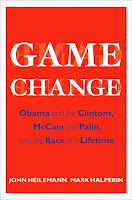
105. Game Change - John Heilemann and Mark Halperin

This book (a.k.a. political thriller) is about the 2008 presidential election. Yes, this is the one that you heard about in the news - the one in which Harry Reid was quoted as saying that Obama had a chance at winning the election because he was a "light-skinned African American" with "no Negro dialect, unless he wanted to have one." It starts with laying out the candidates' decisions to run; covers the bitter debates; and goes into so much more in between.
What really struck me was how the authors exposed sides of the candidates that the public would never see. Some of my favorite parts ...

When Hillary Clinton found out that Democratic Senator Claire McCaskill said on TV, "I think [Bill Clinton] has been a great leader, but I don't want my daughter near him," ...
The phone went quiet. Hillary was speechless. A few more seconds passed, and then finally came her voice, hot with fury.
"Fuck her," Hillary said - and then called Solis Doyle and summarily canceled the fundraiser.
According to Heilemann and Halperin, so much of Hillary's campaign was centered around (and ultimately hurt by) issues with Bill: his alleged continuing affairs; how to control his mouth; and his borderline comments about race (e.g. that Obama would surely win South Carolina during the primaries, because Jesse Jackson did in 1984 and 1988). The "race issues" were quite funny to read about, though. At one point, Hillary wanted to make a commercial portraying Obama as a chameleon.

Penn and Grunwald (Clinton advisers) theorized that Obama, the darling of the left, was pandering to conservative Democrats in northern Nevada. He’s become a chameleon, one of them said.
“He has! We should call him that!” Hillary said, proposing a TV ad that somehow pictured Obama as a color-shifting lizard. “We need a visual,” she said.
“We can’t,” Grunwald replied.
“Why?” Hillary asked.
The color thing, Grunwald said. We’d get hit for dabbling with race.
“Oh Gawwwd,” Hillary groaned. “Give me a break.”

There were also so many fascinating behind-the-scenes stories about Obama. Apparently, he's a lot more cocky than a lot of people might think. Then again ... don't you have to be in order to have the guts to run for president of the United States?? But he also apparently has his emotional side. At one point, Valerie Jarrett threw a book party for him in her backyard soon after The Audacity of Hope had come out.
Jarrett introduced Obama and spoke about Audacity’s final chapter, in which he wrote about the stress that the demands of his career put on his marriage, the
disruptions to his family life. As Jarrett went on, talking about the sacrifices his wife and girls were making, she saw that Obama was crying-to the point where he couldn’t manage to speak when it came his turn. Michelle walked over, put her arm around him, and began to cry as well.
Even Obama’s closest friends had never seen him choke up in public before. He’s not emoting about the past, Jarrett thought. He’s emoting about the future. About the fact the sacrifices he’s imposed on his family are only just beginning.

The writers also exposed a lot about the John Edwards-Rielle Hunter story. How ironic that John Edwards finally came forward two weeks before this book came out and admitted that he had fathered her child. Many of his campaign staffers had been trying so hard to keep her away from him, knowing what was going on. And not that this in any way justifies his actions, but Elizabeth was apparently "an abusive, intrusive, paranoid, condescending crazy-woman" who walked all over Edwards. What a stark contrast from her image as the cancer-surviving, supportive politician's wife.

I wish the authors had included more about the McCain-Palin side of the story. But a few funny pieces were that one of McCain's favorite outfits off-camera is a dress shirt and boxer shorts (eww) and that McCain, Lindsey Graham, and Joe Lieberman would watch the YouTube clip of John Edwards fixing his hair and roll on the floor with laughter. Also, the media has already exposed stories about McCain's temper, but this part was funny:
McCain was erupting over everything. At a scheduling meeting to discuss [his daughter] Meghan’s college graduation, McCain learned that the commencement was a multiday affair that would require him to make several round trips to New York. “How many fucking times do I have to go to fucking New York this week?” he yelled. “How many fucking times can you fucking graduate from fucking Columbia?”

There wasn't anything too shocking about Palin in there - I think the media has already done a pretty good job exposing her ridiculousness. But a small excerpt shows just how hardcore these campaigns are ... something had come up about Palin, and the staffers were not getting direct answers from her and so they had to check it out themselves.
Schmidt wanted to get them on the horn and have the history of her AIP registration checked out immediately.
"But it's two in the morning in Alaska," someone said.
"The phones don't work at fucking night there?" Schmidt bellowed. "Call them! And keep calling them until they pick up!"

Overall, the writing was exquisitely entertaining. The authors call Hillary's camp "Hillaryland" and Edwards' camp "the Edwardsphere." And read how they describe one of Obama's speeches in Iowa:
With a law professor's attention to detail and a litigator's argumentativeness -- plus a hint of the defensiveness of a politician under fire -- he included rebuttals to almost every criticism that Clinton had hurled at him down the homestretch.

Brilliant! It's interesting to note that a lot of the "quotes" are actually not in quotation marks ... in the preface, the authors point out that this was purposeful and was to show that the person remembering the supposed "quote" might not have been able to remember the exact verbiage - but that the idea was close enough.

This was a long book ... but unlike The Poisonwood Bible (notwithstanding the completely different genre), it was impossible to put down.