Thursday, November 19, 2009

71. House of Sand and Fog - Andre Dubus III

Instantly a top-5 choice. A simply beautiful story.
The book begins from the point of view of Colonel Behrani, a man who was once wealthy in Iran and is now a struggling immigrant in California. He has blown most of his money trying to keep up appearances in the U.S., and is struggling to make ends meet for his family. He sinks what money he has left into a house that he buys at an auction, not knowing the direction in which the purchase would lead his family ...
The next chapter is told from the point of view of Kathy Niccolo, the former owner of the house that Colonel Behrani bought. Kathy is incredibly emotionally unstable: her husband has recently left her, and the house (an inheritance from her dad) is all that she has left. When the house is foreclosed upon, Sheriff Lester Burdon helps her try to get it back - but ends up falling in love with her. Lester ultimately becomes obsessed with Kathy and with helping her try to get the house back.
For the majority of the book, the chapters alternate in terms of from whose point of view they are told. The author does an excellent job of making the reader feel what the character was feeling. He perfectly captures the way in which Colonel Behrani and his family, as recent Iranian immigrants, speak English; he also does a great job at weaving in a lot of Persian/Iranian culture. I could feel how determined Colonel Behrani is to keep the house: to him, it's his key to the American dream and to redeeming himself as the provider for his family.
In the chapters told from Kathy's point of view, I could feel her desperation and her feelings for Lester. Some chapters later in the book are told in third person, and in those chapters I could feel Lester's confusion and how torn he was between his developing obsession for Kathy and his pain in leaving his wife and children.
While I was reading this, I was so into it that I got annoyed when the phone would ring and interrupt me. I didn't want to put it down! I plan on renting the movie this weekend (it was made into a movie that came out in 2003) - I hope it doesn't disappoint me!

Wednesday, November 18, 2009

70. The Hitchhiker's Guide to the Galaxy - Douglas Adams

What a strange book ...
In the first chapter, Arthur Dent is upset that bulldozers are about to demolish his house. His neighbor, Ford Prefect (an alien who's been posing as an out of work actor on earth), comes over and tells Arthur that he has to tell Arthur the most important thing he's ever heard ... that the earth is about to be demolished to make space for a freeway. Suddenly, the loss of Arthur's house doesn't seem that terrible ...
The rest of the book is about Arthur and Ford's adventures as they travel through the galaxy. Some parts of this book were just downright strange ... maybe they were above my head, or not just my kind of humor? Although I do know that I'm not much of a sci-fi fan, except for Star Trek (I know, go figure). But it definitely did have its funny points. One of my favorites:

A voice comes in and announces that "the plans for development of the outlying regions of the Galaxy require the building of a hyperspatial express route" ... and that "regrettably, [earth] is one of those scheduled for demolition." When the people of earth start panicking and objecting, the voice tells them that all of the planning charts and demolition orders have been on display in Alpha Centauri for fifty years ... so they've "had plenty of time to lodge any formal complaint and it's far too late to start making a fuss about it now ... What do you mean you've never been to Alpha Centauri? For heaven's sake, mankind, it's only four light-years away, you know. I'm sorry, but if you can't be bothered to take an interest in local affairs that's your own lookout. Energize the demolition beams."

I also like this part:

"One of the things Ford Prefect had always found hardest to understand about humans was their habit of continually stating and repeating the very obvious, as in It's a nice day, or You're very tall, or Oh dear you seem to have fallen down a thirty-foot well, are you all right? At first Ford had formed a theory to account for this strange behavior. If human beings don't keep exercising their lips, he thought, their mouths probably seize up. After a few months' consideration and observation he abandoned this theory in favor of a new one. If they don't keep on exercising their lips, he thought, their brains start working."

There are some die hard Douglas Adams fans out there, so even though I was left a bit bewildered ... maybe it was just me. Give this book a try :)

Sunday, November 15, 2009

69. The Measure of a Man: A Spiritual Autobiography - Sidney Poitier

This is a great story (although I'm not quite sure what makes it a "spiritual autobiography") of the life of actor Sidney Poitier. Poitier talks about growing up very poor in the Bahamas; moving to Miami with his brother when he was a teenager; and eventually moving to New York where he worked as a dishwasher and eventually started taking drama classes and started acting.
The first few chapters moved a bit slowly for me; the book picked up a bit about a quarter of the way through when he talks about his time in the army. After having joined the army, Poitier realized that it had been a bad decision. His anger about the decision started seeping out, and he threw a chair at the head of one of his senior officers. Here is a passage from when he's talking about being faced with a court martial:

"...The act was premeditated. Yes. And calculatedly designed. Yes. But not to do harm. My scenario called for the chair to miss that officer by inches. And in fact it did ... My overall purpose was aimed at something other than that officer's head. An excuse was my immediate objective. My actions were a shameful attempt to establish an excuse that would allow me to eventually walk away from obligations I had freely and solemnly assumed. Simply put, I wanted to get the hell out of the army."

Some parts of the book were quite interesting - like Poitier's description of his first interaction with Spencer Tracy and Katharine Hepburn before they filmed Guess Who's Coming to Dinner; his explanation of how he goes deep inside himself to to make a connection with the character he's playing when he's acting; and also his work with the play A Raisin in the Sun. So although the story of Poitier's life is certainly interesting, I wouldn't say that the book itself was spectacular.

Friday, November 13, 2009

68. Animal Farm - George Orwell

What a strange/interesting/hilarious book ...
Animal Farm is a brilliant commentary on the corruption of the Russian Revolution ... in the form of a satire. A barnyard full of animals revolt against their human masters in the hopes of achieving an idealistic state of justice and progress. The revolt is initially a success: the animals meet to debate farm policy and complete the harvest. The pigs are the most intelligent animals and are therefore put in charge; Napoleon (one of the pigs) is initially the leader of all of the animals. Some premises behind the revolt ...

"Whatever goes upon two legs is an enemy. Whatever goes up on four legs, or has wings, is a friend. And remember also that in fighting against Man, we must not come to resemble him. Even when you have conquered him, do not adopt his vices. No animal must ever live in a house, or sleep in a bed, or wear clothes, or drink alcohol, or smoke tobacco ... All habits of Man are evil."

They even set forth the "Seven Commandments," one of which is "No animal shall sleep in a bed." Yet throughout the story, when Napoleon and the other pigs start (among other things) sleeping in beds ... the commandment changes to, "No animal shall sleep in a bed ... with sheets."

The farm is doing well, although "it seemed as though the farm had grown richer without making the animals themselves any richer ..." except, of course, for the pigs. The pigs start taking on many qualities of their human oppressors, including walking on their hind legs and gambling. The Seven Commandments are eventually reduced to a single law: "All animals are equal; but some animals are more equal than others." The book ends with a drawing (yes, it has sketches!) of the pigs sitting around a table playing cards ... looking like strange pig-human hybrids.

I might have appreciated the book even more than I did if I knew a bit more about the Russian Revolution; nonetheless, I know enough about Communism to have gotten the gist and to have definitely found the book very, very funny!

Wednesday, November 11, 2009

67. Push - Sapphire

This incredibly sad and moving book was the basis for Tyler Perry's most recent movie, Precious. The story is about Claireece Precious Jones: an obese, illiterate, dark-skinned, HIV positive teenager in Harlem - who had a daughter at twelve by her sexually abusive father, and who was pregnant again with another one of his children by the age of sixteen. It's impossible to read this book and not be overwhelmed with emotion for this poor girl. From one passage, where Precious was describing her life not long after the birth of her first child who has Down Syndrome:

"Sometimes I wish I was not alive. But I don't know how to die. Ain' no plug to pull out. 'N no matter how hard I feel my heart don't stop beating and my eyes open in the morning. I hardly have not seen my daughter since she was a little baby. I never stick my bresses in her mouth. My muver say what for? It's outta style ... She say I never do you. What that child of yours need tittie for? She retarded. Mongoloid. Down Sinder."

She actually called the baby "Little Mongo" throughout the book ... I was hoping that was some awful nickname that she gave the baby, but no other name was ever shared. From another passage, talking about her son ...

"When he grow up he gonna laff big black girls? He gon' laff at dark skin like he got? One thing I say about Farrakhan and Alice Walker they help me like being black. I wish I wasn't fat but I am. Maybe one day I like that too, who knows."

The author certainly doesn't hold back: some parts were incredibly, incredibly ... raw. I was shocked. Other parts aren't as explicit but make you want to cry:

"I always thought I was someone different on the inside. That I was just fat and black and ugly to people on the OUTSIDE. And if they could see inside me they would see something lovely and not keep laughing at me, throwing spitballs (shit one time nigger at school just spit on me when I was pregnant) and polly seed shells at me, that Mama and Daddy would recognize me as ... as, I don't know, Precious!"

Definitely one of those books that leaves you feeling very emotionally drained; but thankfully, the ending does leave the reader with hope.

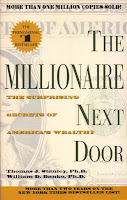
66. The Millionaire Next Door: The Surprising Story of America's Wealthy - Thomas J. Stankley and William D. Danko

How do the rich people in this county become wealthy? Not in the ways that you may think! In this fascinating book, the authors share their research based on interviews spanning over twenty years with America's millionaires (those with a net worth of more than $1 million). An important point to make: your net worth is definitely not the same as your income. In fact, the authors use an interesting formula in computing one's net worth: "Multiply your age times your realized pretax annual household income from all sources except inheritances. Divide by ten. This, less any inherited wealth, is what your net worth should be." So someone can have a really high income but low net wealth ... which is actually the case of a huge percentage of America's high income earners. Too often, the high income earners become overly concerned with displaying a high social status and therefore don't accumulate the net worth that they should, relative to their incomes, to be considered "wealthy." "It is much easier in America to earn a lot than it is to accumulate wealth." Take this into consideration:

"... approximately 70,000 Mercedes were sold in this country last year. This translates into about one-half of 1 percent of the more than fourteen million motor vehicles sold. At the same time, there were nearly 3.5 million millionaire households. What does this tell us? It suggests that the members of most wealthy households don't drive luxury imports. The fact is that two out of three purchasers or leasers of foreign luxury motor vehicles in this country are not millionaires."

... and I bet 90% of those people live right here in flashy Atlanta! The authors share fascinating information, summed up into seven common denominators, among those who successfully build wealth. There's no point in my listing them all here because they won't make much sense without context; but they include living below their means; allocating time, energy, and money in ways conducive to building wealth; believing that financial independence is more important than displaying social status; and choosing the "right" occupation.

An interesting overall point: 80% of America's millionaires are first-generation millionaires - i.e. they did not inherit their wealth from their parents! Maybe if some of us were as quick to invest in the stock market and real estate as we were to go buy a Benz as soon as we come across any money, we would be a lot better off.

This book is definitely top-5 status. A must-read!

Monday, November 9, 2009

65. The Physics of Star Trek - Lawrence M. Krauss

I know, I know. My secret's out.
I'm a Trekkie.
As much as I want to say that "anyone can enjoy this book" (in the way that I think anyone could enjoy many of the movies), the truth is that you will probably miss 95% of what the author is talking about if you've never seen an episode of Star Trek. But ... bear with me anyway :)
Krauss explores the physics behind the show (all spinoffs except the most recent one, Enterprise) and speculates about which pieces of technology might actually exist some day - and which are completely against the laws of physics.
One of my favorite chapters was about the transporter (non-Trekkies: the thing they use to "beam" from one location to another; think, "Beam me up, Scotty!" ... although Captain Kirk never actually said that phrase in any episode or movie! The closest he came was, "Scotty, beam us up" ... but I digress.). The idea came about because Gene Roddenberry's design of the Enterprise was such that the ship glided through space easily; but it would have a lot of trouble with its footing if it ever tried to land. Plus, "...the meager budget for a weekly television show precluded landing a huge starship every week." And what kind of plot would you have if you didn't interact with the people on the planets you encounter?! Cutting through all the techno-jargon, Krauss basically explains that transporter beams will never work; though holodecks and holograms are quite possible. Just look at the holographic technology that exists already!
One of my other favorite chapters was a list of the author's favorite physics "bloopers" on Star Trek. (I'm quite aware that I've lost 90% of my cool points by now). An example: whenever someone shoots a phaser beam, we see the beam of light. But that's a problem because light is not visible unless it reflects off of something.
"If you have ever been to a lecture given with the help of a laser pointer ... you may recall that you see only the spot where the beam hits the screen, and not anything in between. The only way to make the whole beam visible is to make the room dusty ... Thus, unless empty space is particularly dusty, we shouldn't see the phase beam except where it hits."
How disappointing! But honestly, the most interesting parts of this book were those that showed some absolutely amazing accuracy and even foresight in some instances on the part of the writers.
Clearly, if you're a Trekkie, you'll enjoy this book. If you're not ... moving on to book #66 ...