Monday, April 5, 2010

107. The Essential Writings of Machiavelli - Niccolo Machiavelli

The Prince instantly became one of my favorite books - so I had to go out and buy The Essential Writings of Machiavelli. This book has more of his political essays, as well as historical and philosophical essays, personal letters, and even some satire/fiction. I'll just share my thoughts on some of the pieces that jumped out to me the most:

The Discourses
For all of those who think of Machiavelli only as being the pejorative adjective created from his name, read The Discourses! True, The Prince was about how to be the ideal autocratic ruler - but The Discourses actually advocates for a republican form of government. Although it was written around 1513, the similarities between Machiavelli's lessons and how the United States was established are striking. In chapter two, he discusses checks and balances, the strength of a tri-partite political structure, and how a republic is superior to a principality.
In fact, when there is combined under the same constitution a prince, a nobility, and the power of the people, then these three powers will watch and keep each other reciprocally in check.
In another chapter, Machiavelli argues that a ruler who wants to reform an old system of government in a free state must "keep at least a veneer" of the older institutions ... because "Men cherish something that seems like the real thing as much as they do the real thing itself: In fact, they are more often affected by that which seems than by that which is."

I do have to admit that while Machiavelli provides a lot of advice on how to establish a republic, he also provides advice on how to overthrow one.

Rules for an Elegant Social Circle
This short piece is a hilarious satire of 16th century Florentine culture, and is essentially a list of rules for dinner parties.
The lady or gentleman of the circle who can say the most while meaning the least will be held in highest esteem and honored above all others of the company ...

No lady of the company may have a mother-in-law. Should one of the ladies be inconvenienced by one, said lady will have to dispose of her within six months by a purgative or some such means, which may also be used against a husband who does not fulfill his obligations.

Ha!!! Some of the pieces (i.e. Florentine Histories) were quite dry and uninteresting in my opinion - but I recommend this book to anyone who enjoyed The Prince and to anyone who thinks that "Machiavellian" writing is all that Machiavelli had to offer!

Tuesday, February 23, 2010

106. How to Be Safe in an Unsafe World - Harold H. Bloomfield & Robert K. Cooper

The blog lives! But I'm sorry that I had to bring it back with this book ...
This book is about what the authors call "safety intelligence." The discussion of inner security reminded me a lot of what Malcolm Gladwell talked about in Blink: how to avoid "emotional paralysis" by observing a situation in a small amount of time and maintaining a state of heightened awareness, calmness, and power.
The authors also offer practical tips to increase your sense of inner security and external safety that I, living in a big city, found quite helpful. For example, research demonstrates that it takes only seven seconds for an attacker to "size up" a potential victim - and that even by changing the way that you walk can deter an attack. Research also shows that yelling "help" when confronted with danger actually discourages assistance; but yelling "fire" will distract an assailant and will be more likely to attract the aid of bystanders. The book also gives suggestions on what to do if confronted with a stalker; if you're carjacked; if you're the victim of an incident of road rage; and also if you have to deal with an aggressive date or co-worker.
One reason I bought this book was because of the forward by Deepak Chopra (if his name is on it, it has to be good!), but I feel like there are better books out there on the same topic. I suggest you don't waste your time on this one.

Monday, February 15, 2010

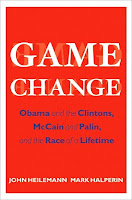
105. Game Change - John Heilemann and Mark Halperin

This book (a.k.a. political thriller) is about the 2008 presidential election. Yes, this is the one that you heard about in the news - the one in which Harry Reid was quoted as saying that Obama had a chance at winning the election because he was a "light-skinned African American" with "no Negro dialect, unless he wanted to have one." It starts with laying out the candidates' decisions to run; covers the bitter debates; and goes into so much more in between.
What really struck me was how the authors exposed sides of the candidates that the public would never see. Some of my favorite parts ...

When Hillary Clinton found out that Democratic Senator Claire McCaskill said on TV, "I think [Bill Clinton] has been a great leader, but I don't want my daughter near him," ...
The phone went quiet. Hillary was speechless. A few more seconds passed, and then finally came her voice, hot with fury.
"Fuck her," Hillary said - and then called Solis Doyle and summarily canceled the fundraiser.
According to Heilemann and Halperin, so much of Hillary's campaign was centered around (and ultimately hurt by) issues with Bill: his alleged continuing affairs; how to control his mouth; and his borderline comments about race (e.g. that Obama would surely win South Carolina during the primaries, because Jesse Jackson did in 1984 and 1988). The "race issues" were quite funny to read about, though. At one point, Hillary wanted to make a commercial portraying Obama as a chameleon.

Penn and Grunwald (Clinton advisers) theorized that Obama, the darling of the left, was pandering to conservative Democrats in northern Nevada. He’s become a chameleon, one of them said.
“He has! We should call him that!” Hillary said, proposing a TV ad that somehow pictured Obama as a color-shifting lizard. “We need a visual,” she said.
“We can’t,” Grunwald replied.
“Why?” Hillary asked.
The color thing, Grunwald said. We’d get hit for dabbling with race.
“Oh Gawwwd,” Hillary groaned. “Give me a break.”

There were also so many fascinating behind-the-scenes stories about Obama. Apparently, he's a lot more cocky than a lot of people might think. Then again ... don't you have to be in order to have the guts to run for president of the United States?? But he also apparently has his emotional side. At one point, Valerie Jarrett threw a book party for him in her backyard soon after The Audacity of Hope had come out.
Jarrett introduced Obama and spoke about Audacity’s final chapter, in which he wrote about the stress that the demands of his career put on his marriage, the
disruptions to his family life. As Jarrett went on, talking about the sacrifices his wife and girls were making, she saw that Obama was crying-to the point where he couldn’t manage to speak when it came his turn. Michelle walked over, put her arm around him, and began to cry as well.
Even Obama’s closest friends had never seen him choke up in public before. He’s not emoting about the past, Jarrett thought. He’s emoting about the future. About the fact the sacrifices he’s imposed on his family are only just beginning.

The writers also exposed a lot about the John Edwards-Rielle Hunter story. How ironic that John Edwards finally came forward two weeks before this book came out and admitted that he had fathered her child. Many of his campaign staffers had been trying so hard to keep her away from him, knowing what was going on. And not that this in any way justifies his actions, but Elizabeth was apparently "an abusive, intrusive, paranoid, condescending crazy-woman" who walked all over Edwards. What a stark contrast from her image as the cancer-surviving, supportive politician's wife.

I wish the authors had included more about the McCain-Palin side of the story. But a few funny pieces were that one of McCain's favorite outfits off-camera is a dress shirt and boxer shorts (eww) and that McCain, Lindsey Graham, and Joe Lieberman would watch the YouTube clip of John Edwards fixing his hair and roll on the floor with laughter. Also, the media has already exposed stories about McCain's temper, but this part was funny:
McCain was erupting over everything. At a scheduling meeting to discuss [his daughter] Meghan’s college graduation, McCain learned that the commencement was a multiday affair that would require him to make several round trips to New York. “How many fucking times do I have to go to fucking New York this week?” he yelled. “How many fucking times can you fucking graduate from fucking Columbia?”

There wasn't anything too shocking about Palin in there - I think the media has already done a pretty good job exposing her ridiculousness. But a small excerpt shows just how hardcore these campaigns are ... something had come up about Palin, and the staffers were not getting direct answers from her and so they had to check it out themselves.
Schmidt wanted to get them on the horn and have the history of her AIP registration checked out immediately.
"But it's two in the morning in Alaska," someone said.
"The phones don't work at fucking night there?" Schmidt bellowed. "Call them! And keep calling them until they pick up!"

Overall, the writing was exquisitely entertaining. The authors call Hillary's camp "Hillaryland" and Edwards' camp "the Edwardsphere." And read how they describe one of Obama's speeches in Iowa:
With a law professor's attention to detail and a litigator's argumentativeness -- plus a hint of the defensiveness of a politician under fire -- he included rebuttals to almost every criticism that Clinton had hurled at him down the homestretch.

Brilliant! It's interesting to note that a lot of the "quotes" are actually not in quotation marks ... in the preface, the authors point out that this was purposeful and was to show that the person remembering the supposed "quote" might not have been able to remember the exact verbiage - but that the idea was close enough.

This was a long book ... but unlike The Poisonwood Bible (notwithstanding the completely different genre), it was impossible to put down.

104. The Secret of Divine Civilizaiton - Abdu'l-Baha

This book was first written by Abdu'l-Baha in 1875 and was addressed to the people of Persia (Iran). It is known for its attempt to improve the degraded conditions of Persia: the poverty, corrupt government, and lack of education, especially for women. This book actually sort of reminded me of Plato's Republic (at least, the small amount I understood from The Republic!) in that Abdu'l-Baha examines what is needed to make a "just society." He argues that religion should be a binding force for love and not of ignorant prejudice, and he tries to reconcile the schism between religion and politics.
It's interesting to compare many of the issues that were being debated back then to what is in the news about Iran now: such as whether modernize and accept Western technology, or to reject Western culture and rely on technology developed in the Islamic world. In this book, Abdu'l-Baha shows the great changes that took place in Western culture as a result of the revelations of Jesus.
In discussing the government of Persia, Abdu'l-Baha warned that great results cannot be expected unless the members elected are qualified: "righteous, God-fearing, high-minded, incorruptible ... fully cognizant ... versed in the rules which govern the management of internal affairs and the conduct of foreign relations, skilled in the useful arts of civilization, and content with their lawful emoluments." He also discussed in depth a quote from Muhammad as it relates to this issue of finding the right people to serve in the government needed to improve the country: "As for him who is one of the learned: he must guard himself, defend his faith, oppose his passions and obey the commandments of his Lord."
To be honest, this book was very, very hard for me to read. You can tell that it was translated from Arabic (or Farsi) into English and that it was written over a century ago, because the English was very old and formal. Nonetheless, a good read.

Thursday, January 14, 2010

103. The Poisonwood Bible - Barbara Kingsolver

This is a great novel by Barbara Kingsolver about a missionary family (the Prices) that goes to the Congo in the 1960's. The story is narrated by the five women of the Price family: the mother, Orleanna; Rachel; Leah and Adah (twins); and Ruth May.
Each girl goes through her own struggle as she tries to adapt to the African village and to her father's issues with women and borderline narcissism. I could relate to the girls' struggle based on my experiences when I went to live in Benin when I was in seventh grade (in the story, the girls actually visit Benin and go to some of the same places that I did - I was thrilled, it was quite accurate). This part in particular made me smile - Rachel is upset that her father, the overzealous Baptist minister, seems to want to stay in the Congo forever. It reminded me a little of myself back then, melodrama and all:
I screamed and kicked the furniture until one whole leg came off the table and threw a hissy fit they could probably hear all the way to Egypt. Listen, what else can a girl to but try. Stay here? When everybody else gets to go home and do the bunny hop and drink Cokes? It is a sheer tapestry of justice.
This part made me laugh out loud (also, from Rachel):
I stood and prayed to the Lord Jesus if he was listening to take me home to Georgia, where I could sit down in a White Castle and order a hamburger without having to see its eyes roll back in its head and the blood come spurting out of its corpse.
The girls' father is determined to stay in the Congo and "dunk the head of every last person in that village into the river." But after the youngest daughter (Ruth May) dies, and the women realize that they have worn out their welcome in the village, they give up and each go their separate ways.
To me, this is where the story got the most interesting. Rachel stays in the Congo - though she seems to have the most contempt for Africa out of everyone in the family. She is very beautiful and conceited - characteristics that probably ultimately help her run the hotel that she opens in the Congo.
Of course you have to look the other way when the train goes by the townships, because those people don't have any perspective of what good scenery is, that's for sure. They will make their houses out of a piece of rusted tin or the side of a crate - and leave the writing part on the outside for all to see! But you just have to try to understand, they don't have the same ethics as us. That is one part of living here. Being understanding of the differences.
Adah ends up going to school at Emory and becomes a successful epidemiologist. Leah marries a Congolese named Anatole and has four boys with him. Leah works tirelessly with Anatole to improve the lives of the Congolese and, of the four daughters, she is the most upset about the cultural arrogance of the West.
I wake up in love, and work my skin to darkness under the equatorial sun. I look at my four boys, who are the colors of silt, loam, dust, and clay, an infinite palette for children of their own, and I understand that time erases whiteness all together.
At one point, Leah and Anatole visit Adah in Atlanta. Being in Atlanta now, I had to appreciate this part:
[Anatole] laughs out loud at the nearly naked women on giant billboards, and befriends the bums who inhabit the street corners of Atlanta, asking them detailed questions about where they sleep and how they kill their food. The answers are interesting. You might be surprised to know how many pigeons roosting in the eaves of Atlanta's Public Library have ended up roasting over fires in Grant Park.
Classic - don't you love the alliteration in "roosting" and "roasting"?! The character development of Rachel, Adah, and Leah is wonderful. The only bad thing I can say about this book is that it was waaaay too long. Almost 550 pages! But if you have the time and/or the patience, it's a wonderful work of fiction - one that really makes you think.

Sunday, January 10, 2010

102. The Male Factor: The Unwritten Rules, Misperceptions, and Secret Beliefs of Men in the Workplace - Shaunti Feldhahn

I would sum this book up as the workplace edition of Men are from Mars; Women are from Venus. Written by Shaunti Feldhahn (she also wrote the For Women Only and For Men Only series), this book is based on confidential interviews that she conducted with more than three thousand men about how men tend to think in work environments. Some of the information is basic - for example, it's almost common knowledge now that women are often better at multi-tasking, while men tend to have one-track minds. But Feldhahn explores this issue a bit deeper (and uses a great analogy of women being like a computer that can have many windows open at once that you can click and switch between; and men being like a computer than can only have one window open at a time, and you have to close one before you can open another) by explaining how this can affect how men and women in the workplace. For example, we know that women (generally) tend to be more emotional than men. But because men have more of a one-track mind, when a man perceives a woman as being emotional about something at work, he is more likely to assume that she is not getting work done because he figures that she is like him and can't do more than one thing at one time (i.e. be emotional and be effective at work).
Further, men are much more likely to perceive someone who is emotional as violating the rules of the business world - i.e. being "unbusinesslike." So what's the moral of the story, per Feldhahn? "If something might evoke personal world, don't let a man see it."

Here's a passage from the chapter on emotion:
The issue of managing emotion was one of the top topics that came up in my interviews; men clearly thought that an inability to manage emotion well was a way talented women sometimes shot themselves in the foot. Yet these same men often commended women for their superior empathetic, listening, and interpersonal skills. In short, many men clearly saw the benefits of someone who was "relational" but not "emotional."

Another interesting point that Feldhahn made is that women to be very interested in the process, and men tend to be more interested in the end result. So if an associate is explaining his or her research to a male partner, the partner is much more likely to be interested in the very narrow answer to his question, rather than, "Well, I didn't find anything here, so I checked this resource, but then I had to ask this partner this question because ... and then ultimately I found ..." As one man in Feldhahn's survey put it: "Don't tell me about the pain; just show me the baby!"

Oh - and what about the short skirts and low-cut tops in the workplace?! Even if you don't think your male colleague is looking at your body ... he probably is.
Neuroscientists have consistently found that more areas of the male brain are devoted to visual-spatial processing than in the female brain. By contrast, more areas of the female brain are devoted to verbal and emotional processing. Where a woman's brain predisposes her to experience the world more relationally, a man's brain predisposes him to experience the world more visually.

On top of that - because of hormones like testosterone, men are more likely to perceive certain stimuli as sexual in the first place. So even if you think what you're wearing is "high fashion," a man is more likely to think, "She must want me to look at her chest!"

Of course some people can write off some of what's in this book as "stereotypes," "overgeneralizations," etc. - but to that I say take from it what you will. I'd definitely recommend it to any working woman.

Wednesday, January 6, 2010

101. Think and Grow Rich - Napoleon Hill

This classic business and self-improvement book was first published in 1937, and is arguably one of the most famous self-improvement books today (more than 30 million copies have been sold). It is based on author Napoleon Hill's prior work, The Law of Success, which was the result of research on Hill's close association with people who achieved great wealth during their lifetimes like Thomas Edison, Alexander Graham Bell, Henry Ford, John D. Rockefeller, and Charles Schwab. Apparently, Andrew Carnegie asked Hill to study the characteristics of these men, and from this Hill developed 15 laws of success and 13 principles of personal achievement.
Some of Hill's "laws" are admittedly a bit "obvious": desire, faith, persistence, etc. But the anecdotes from men like those mentioned above certainly do make this a great read. Also, Hill combines these laws with concrete, practical steps by which by which "desire for riches can be transmuted into its financial equivalent."
One of my favorite chapters discusses the "six basic fears" that are centered around negative emotions and can hold you back from achieving success. They are: the fear of poverty; the fear of criticism; the fear of ill health; the fear of loss of love; the fear of old age; and the fear of death.
There's also a great chapter called "The Mystery of Sex Transmutation." From that chapter:
Sex, alone, is a mighty urge to action, but its forces are like a cyclone--they are often uncontrollable. When the emotion of love begins to mix itself with the emotion of sex, the result is calmness of purpose, poise, accuracy of judgment, and balance .... When driven by his desire to please a woman, based solely upon the emotion of sex, a man may be, and usually is, capable of great achievement, but his actions may be disorganized, distorted, and totally destructive. When driven by his desire to please a woman, based upon the motive of sex alone, a man may steal, cheat, and even commit murder. But when the emotion of LOVE is mixed with the emotion of sex, that same man will guide his actions with more sanity, balance, and reason.

After I read this book, I realized that all other business/self-improvement books I've read get their wisdom from this one. So instead of reading all the other ones that are out there, just check out this must-read classic.